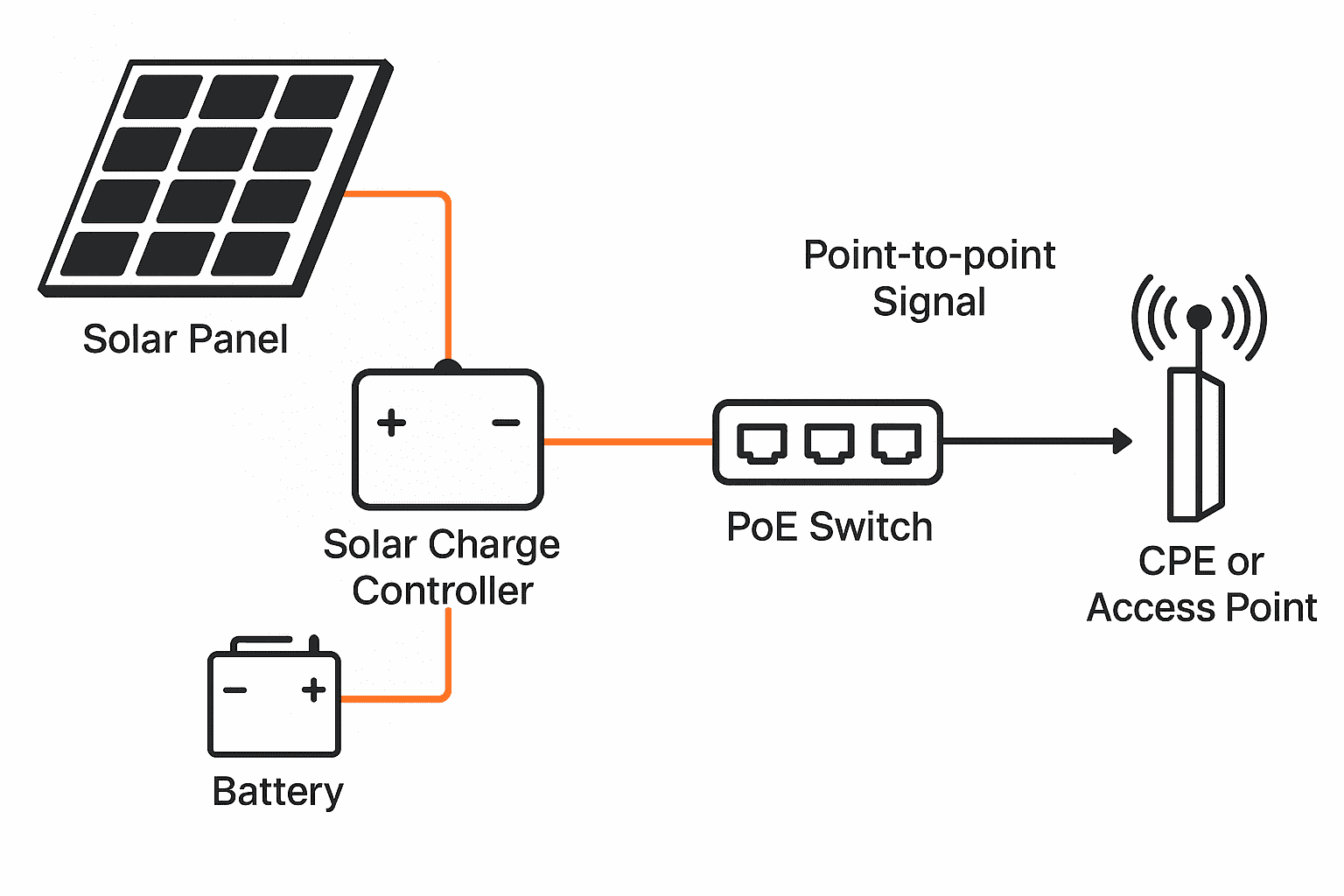
The application of POE in the Internet of Things
The Internet of Things equips sensors with various real objects such as power grids, railways, bridges, tunnels, household appliances, and so on, and connects them through the Internet to run specific programs to achieve remote control or realize direct communication between things. Through the Internet of Things, a central computer can be used to centrally manage and control machines, equipment, and personnel. It can also perform remote control of home equipment and cars, as well as find locations, prevent items from being stolen, and other applications. In many of the above applications, a power supply technology is indispensable, and POE (Power Over Ethernet) is a technology that can transmit power and data to devices through twisted pairs in Ethernet. Through this technology, devices including Internet phones, wireless base stations, network cameras, computers, etc. can be powered by POE technology to complete the operation of various devices. Electronic devices powered by the Internet can be used without additional power sockets, so the time and money of configuring power cords can be saved, making the cost of the entire device system relatively low.
With the widespread application of Ethernet, RJ-45 network sockets are currently commonly used around the world, so various POE devices are compatible. POE can operate without changing the cable structure of the Ethernet network. Therefore, the use of POE system not only saves costs, is easy to wire and install, but also has the ability to power on and off remotely. POE intelligent power supply thus well solves the needs of IoT terminals. The power supply problem will play a very important role in the future development of the Internet of Things.
The main applications of POE in the Internet of Things
With the development of technology and applications, the connotation of the Internet of Things continues to expand, and new understandings have emerged. ——The Internet of Things is the expansion of networks, communications and Internet networks. It uses sensing technology and smart devices to perceive the physical world. Through transmission networks, interconnection, computing, processing and knowledge extraction, they recognize the interaction and seamless connection between people and things, and things and things, achieve real-time control, and make precise management and scientific decisions for the material world. Therefore, the network will no longer passively meet the needs of users, but will actively detect changes in user scenarios and interact with information to provide users personalized services. The current main application scenarios of POE technology in the Internet of Things are as follows:
1. Application of POE wireless AP in the Internet of Things
The impact of wireless network technology on people is indisputable. Wireless LAN applications in office buildings, university campuses, shopping malls, airports, exhibition bars, cafes, etc. need to be connected to the Internet anytime, anywhere. The most important part of achieving network wireless is a reasonable and efficient wireless AP (Access point) installation. The cloud platform can provide a complete set of management in a centralized, reasonable and effective way. In large-scale wireless network coverage projects, the number of wireless aps is large and distributed in various parts of the building, and aps generally need network cables to connect to the switch and external DC power supply. On-site power supply and management can greatly increase the cost of construction and maintenance. The power supply switch solves the centralized power supply problem of wireless AP through cable power supply (POE), which can greatly solve the local power collection and AP management problems encountered in the project construction. Avoid the local power outage, individual aps can not work. In this solution, it is necessary to use AP devices with 802.3af/802.3af protocol functions to achieve the function of network cable power supply. If the AP does not support 802.3af/802.3af protocol functions, it can directly install data and POE synthesizer to complete this power supply function.
2. Application of POE remote monitoring in the Internet of Things
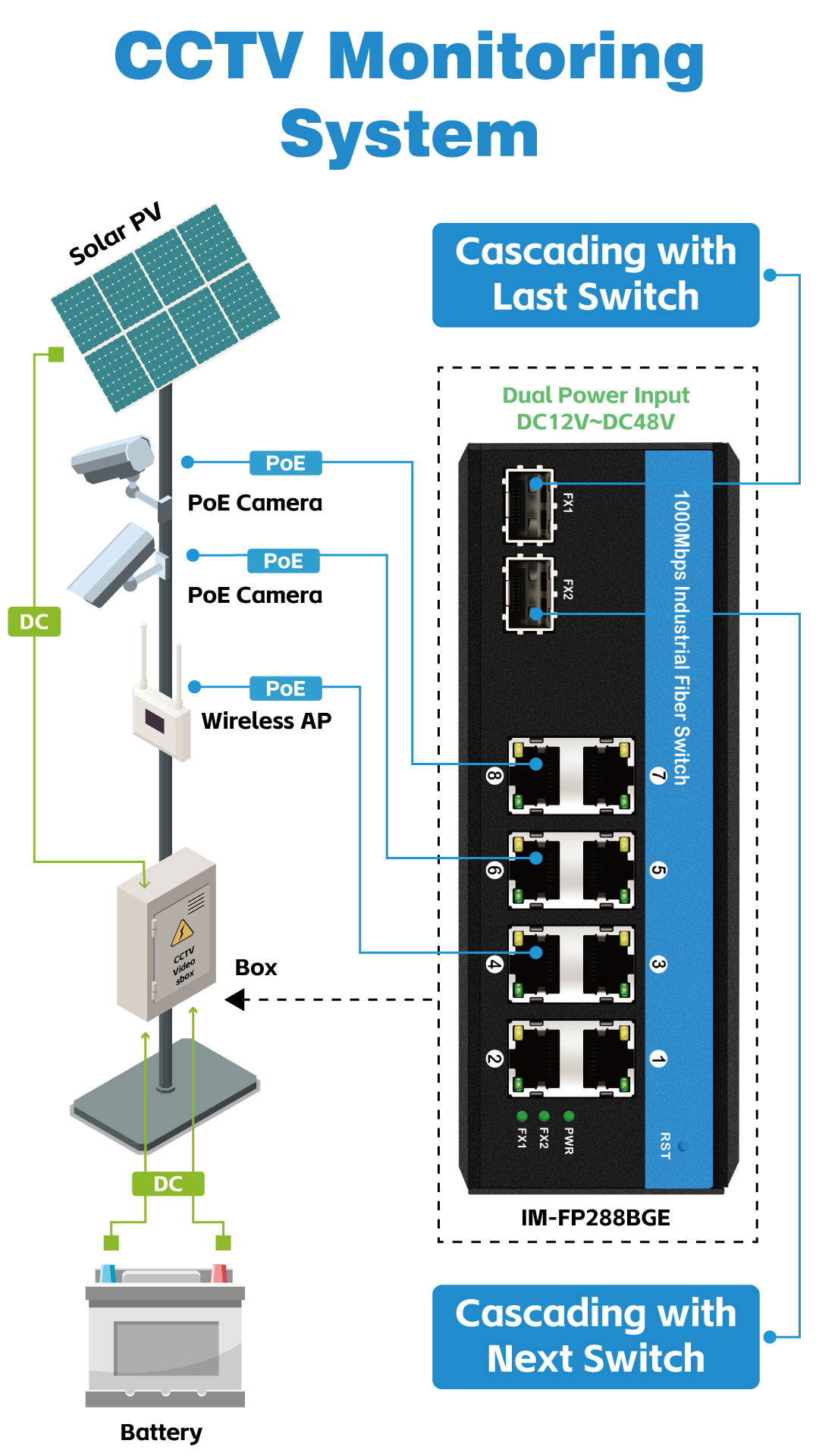
In recent years, due to the rapid development of social economy and information technology, unprecedented demand for video surveillance has arisen in various industries across the country. The fields of application are becoming more and more extensive. In addition to special industries, such as finance, government, transportation, etc., digital surveillance has been implemented or is being implemented in communities, public places, hotels, factories, and shopping malls. The scale and radiation area are getting larger and larger. A typical example is the "Safe China" project, which covers the entire city and has tens of thousands of cameras. Video surveillance products have also evolved from local DVRs to IP camera networks.
However, the installation of network video surveillance equipment is subject to the environment, which seriously affects the development of network video surveillance. In addition to the need to transmit video signals through network cables, network cameras used for network video surveillance must provide sufficient power throughout the day. In the implementation process, it often happens that the installation location of the camera must be redesigned because they cannot provide a stable power supply, and the redesign of the installation location may lead to dead angle monitoring, making security monitoring meaningless.
Usually, a working network camera needs to connect two cables, one network cable and one cable. The following conditions may cause a network monitoring camera to fail to be installed:
1. There is no power supply at the installation location of the camera.
2. The camera is installed with power, but the lighting power supply cannot provide power.
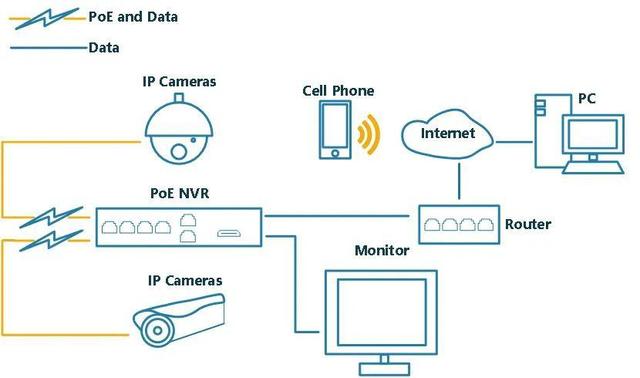
The previous situation made it impossible to install the IP camera, all of which happened with the power supply problem of the IP camera. In order for the network camera to be installed correctly in the desired location, the problem of the network camera power supply must be solved. Since the power supply is not working properly, you should consider using a network cable to power the camera. After all, it is much easier to implement a network cable than a strong cable. If the network cable is used for power supply, the network camera can run as long as the data switch power is not interrupted. . The power supply of a network camera with a network cable can be summarized as follows:
1. The network camera supports the 802.3af/802.3af protocol, and POE power supply equipment can be used to directly power the network camera through the network cable.
2. The network camera does not support the 802.3af/802.3af protocol and cannot directly use POE devices for power supply. At this time, you need to use another supporting equipment - a separator. The separator can separate the network cable with integrated power into a pure data network cable and a power cable. In this way, data and power can be separated to achieve a network cable that transmits data and provides power.
3. Application of POE smart terminals in the Internet of Things
When making a call at home, if there is a sudden power outage, the call will not be interrupted. This is because the power supply to the telephone terminal is directly supplied by the telephone company (central office) switch through the telephone line. Imagine that if modern office equipment such as sensors, controllers and intelligent terminal actuators in industrial sites in the Internet of Things can also be directly powered by Ethernet, then the entire wiring, power supply, labor and other costs may be reduced a lot, and can Extending monitoring to many remote applications is the vision that POE technology depicts for the Internet of Things industrial control industry.
In 2003 and 2009, the IEEE approved 802.3af and 802.3at standards, respectively, which specify power detection and control in remote systems and the way routers, switches, and hubs supply power to devices such as IP phones, security systems, and wireless LAN access points over Ethernet cables. The release of IEEE802.3af and IEEE802.3at has greatly promoted the development and application of POE technology. At present, the industrial Ethernet products of POE technology have been launched to provide reliable and stable power supply for various network terminals in the Internet of Things industrial control, such as temperature detection terminals, humidity detection terminals, signal control terminals, etc.
Conclusion
The Internet of Things is a comprehensive network that covers everything. Ethernet is a very important mode of transmission in the Internet of Things. Online Power (POE) is a revolutionary technology that provides reliable DC power over Class 5 twisted pair cables and extends the already powerful Ethernet capabilities. POE will change the way network equipment works, allowing network administrators to take full advantage of existing network infrastructure and deploy new applications.
The advent of POE technology allows network designers to easily overcome limitations, as power semiconductor manufacturers offer more switches and devices, and new industry standards will allow for higher power levels. It aims to facilitate the emergence of a new generation of IoT applications.
Smart City
What is the industrial internet of things(IIoT)?
Related Article