Network Time Protocol (NTP)
What is Network Time Protocol (NTP)?
Network Time Protocol (NTP) is a widely-utilized protocol that serves the purpose of synchronizing our computer clocks. NTP operates by syncing the clocks of hardware devices and routers present on the Internet. In other words, let the computer synchronize time with its server or clock source, such as GPS, Beidou, quartz clock, etc. The master NTP server is synchronized to a reference clock directly traceable to Coordinated Universal Time (UTC).
NTP server accuracy is expected to depend on environmental application requirements. However, NTP can usually keep the time within tens of milliseconds on the public Internet, and some can even provide high-precision time correction (the difference from the standard is less than 1 millisecond on LAN, and tens of milliseconds on WAN) and can be mediated by Cryptographically confirmed methods to prevent malicious protocol attacks.
In essence, the primary aim of NTP is to provide reliable timing services in an unstable and unpredictable Internet environment.
How does NTP work?
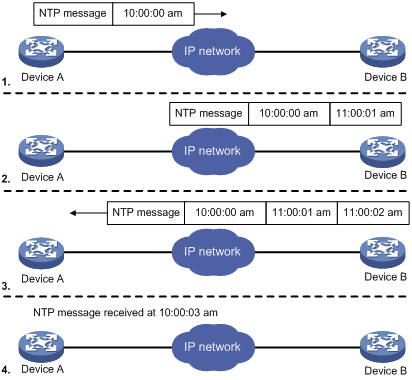
The NTP time synchronization process comprises three steps:
- First, the NTP client sends a time-request message to the NTP server.
- Next, the client calculates the link delay and local offset, then adjusts its local clock to match the server's.
- Normally, setting the clock requires six message exchanges over five to 10 minutes.
- Once synchronized, the client updates its clock every 10 minutes via User Datagram Protocol (UDP) on port 123. Additionally, NTP enables broadcast synchronization of peer computer clocks.
Why is NTP important and how is it used?
Having accurate time synced across all devices in a computer network is crucial for numerous reasons, as even the slightest discrepancy of time can cause major issues. The following are some examples of how Network Time Protocol (NTP) is utilized:
- Coordinated times are necessary for distributed procedures to follow proper sequences.
- Consistent timekeeping throughout the network is essential for secure security mechanisms.
- Synchronized clock times are required for file system updates across multiple computers.
- Accurate timestamps are critical for network acceleration and management systems to measure performance and diagnose problems.
NTP time servers are widely used. The following are some common application scenarios:
1. Computer network: In computer networks, accurate time synchronization is very important, and NTP time servers can ensure that all devices perform tasks at the same time to minimize network delays and errors.
2. Financial trading system: In trading systems, precise timing is paramount. Even a minor time difference could result in transaction failure or loss. NTP time servers can guarantee that all trading systems' clocks are synchronized, avoiding these costly mishaps.
3. Telecommunications network: In telecommunications networks, NTP time servers can ensure that all communication devices perform tasks at the same time to maximize network efficiency and reliability.
Conclusion
In general, the NTP time server communicates with external time sources and transmits accurate time information to other devices in the network, thereby achieving network time synchronization. It is an important part of the global Internet infrastructure and has a significant impact on network security. In the coming years, NTP will continue to evolve and play a vital role in modern computing.
How do industrial Ethernet switches and I/O modules work together in the mining industry?
Why industrial digital transformation is important?
Related Article