Applications of ERPS on Industrial Ethernet Switch
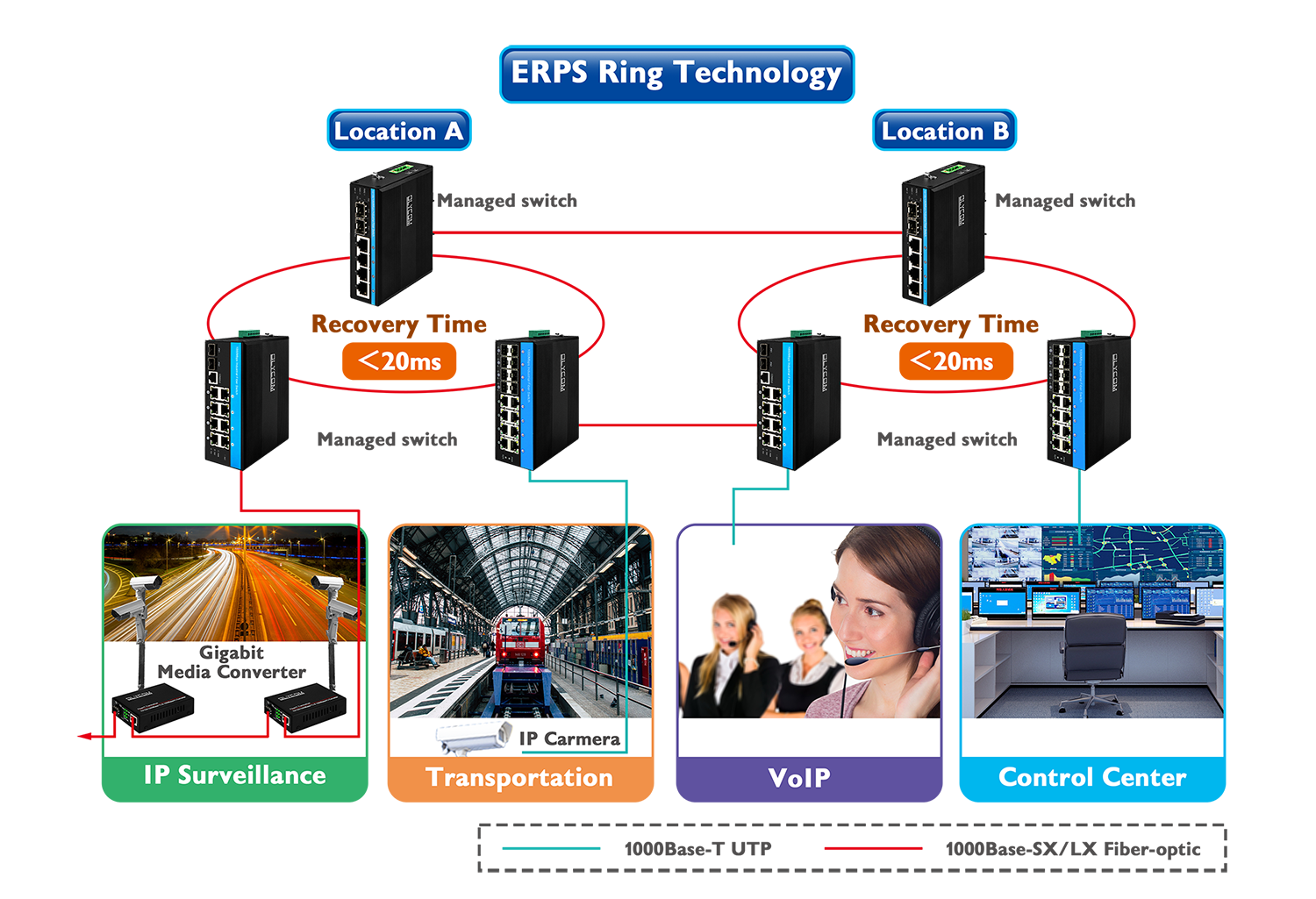
In the interconnected world of today, industrialized networks play a vital role in modern society. Ensuring the protection of these systems against network failures and system outages is of utmost importance. To achieve this, administrators and system engineers rely on redundancy technologies, which provide a failsafe mechanism, allowing for uninterrupted operations, even in the face of a link failure or network outage. One increasingly popular redundancy protocol is Ethernet Ring Protection Switching (ERPS).
What is ERPS( Ethernet Ring Protection Switching) ?
The ITU-T G.8032 Ethernet Ring Protection Switching (ERPS) is a layer 2 Ethernet protocol that is an open-standard designed to detect and prevent switching loops. Initially developed by the Telecom industry for Metro-Ethernet topologies, it is now primarily used in industrial networks to ensure fault-tolerant networks. Similar to other redundant layer 2 protocols such as spanning-tree and rapid spanning-tree, ERPS aims to prevent looping in the event of a node or link failure. The advantage of ERPS over other layer 2 redundant protocols is its ability to quickly reroute traffic in under 50 milliseconds when a link fault is detected. Nevertheless, this rapid reconvergence requires ERPS-specific hardware.
How Ethernet Ring Protection Switching Works?
ERPS operates by establishing a topology of interconnected nodes, which form a ring structure. Every node has a specific set of switch ports - the ring ports - which are programmed with unique attributes utilized for messaging and link status updates. These ring ports interconnect adjacent nodes, ultimately forming the complete ring.
ERPS rings can be configured as a single or multi-site domain, with each domain featuring a primary ring and the option for sub-ring configurations. To facilitate communication, each domain utilizes a control channel or VLAN, which transmits status messages throughout the entire ring domain.
Each ERPS ring can be managed by either a single node or a pair of nodes, referred to as the Owner and Neighbor. In a single-node setup, the primary node acts as the Owner. In a dual-node configuration, the two management nodes are utilized to ensure the network's integrity.
The Owner node holds the deciding power, selecting which ring port blocks data traffic. The link bridging the Owner to its adjacent node is called the Ring Protection Link (RPL). During normal operations, the RPL link is blocked, allowing only control messages to travel through while halting all other data traffic. However, in case of a fault detection, the RPL link changes from a blocking to forwarding state, paving the way for an alternate flow path. This switching mechanism plays a critical role in preventing switching loops and maintaining network integrity.
Applications of ERPS on Industrial Ethernet Switch
Industrial Ethernet faces a multitude of challenges due to its operating conditions, making a standard Ethernet switch inadequate. Machines running in industrial settings generate harsh environmental conditions, coupled with fluctuating conditions and a need for time synchronization, further complicating the selection of networking equipment. Hardened switches offer a solution.
With multiple applications operating simultaneously in these environments, network traffic is substantially higher, necessitating a superior traffic control mechanism. The reliable Ethernet Ring Protection Switching (ERPS) protocol provides the best resolution. Additionally, Ethernet G.8032 standard plays a vital role in maintaining network performance by effectively controlling and managing traffic flow.
For industrial sites such as mines (coal mines, iron mines, various large mining areas, and operating companies) that require high convergence speeds, ERPS uses selectively blocked redundant network links to prevent network broadcast storms and unstable MAC address tables. It can achieve millisecond-level link recovery, effectively ensuring user communication quality. Nowadays, many industrial communication fields have introduced ring network switches. These ring network switches can not only form ring networks but also avoid broadcast storms and achieve ring network reliability. As an industrial Internet solution provider, Olycom Technology's ring network switches have good reputation in the industry and can meet the various needs of customers.
What is industrial automation?
What is SNMP and How it works?
Related Article