What is Media Redundacncy Protocol(MRP)?
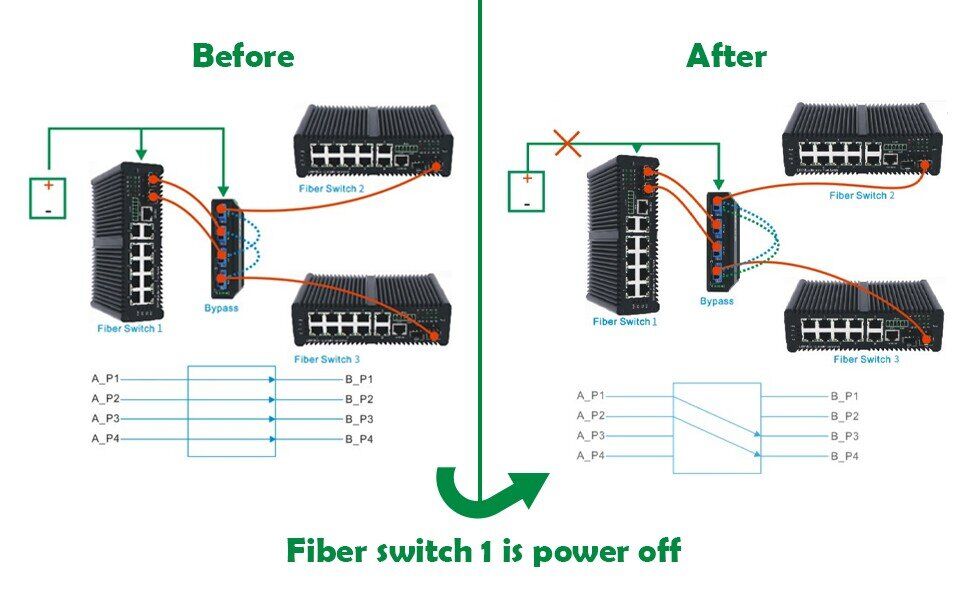
Media Redundancy Protocol (MRP) is a data network protocol that supports the IEC 62439-2 standard developed by the IEC organization. It allows Ethernet switches to be connected in a ring to obtain a faster recovery time than the spanning tree protocol in the event of a single point of failure. , which is suitable for most industrial Ethernet applications.MRP enables a seamless transition between active and backup network paths in the event of a link failure, ensuring a continuous flow of communication between devices.
As specified in IEC 62439-2, MRP ensures deterministic switchover times of less than 500 milliseconds in the worst case and often even faster, minimizing network downtime. This is critical for industrial applications, especially in environments that require high reliability and fast response times.
MRP and RSTP comparison
MRP (Media Redundancy Protocol) and RSTP (Rapid Spanning Tree Protocol) are two different protocols that provide failure recovery mechanisms in industrial networks.
Topology:
·MRP: Achieves redundancy by forming a physical loop based on ring topology.
·RSTP: Supports any topology, including star and mesh.
Maximum device support:
·MRP: Supports up to 50 nodes and is ideal for smaller ring topologies.
·RSTP: Theoretically, can support any number of nodes and is better suited for larger and more complex networks.
Worst case reconfiguration time:
·MRP: Provides strict determinism with a worst-case reconfiguration time of 10 milliseconds.
·RSTP: Reconfiguration time depends on network complexity and can exceed 2 seconds.
Applicable topology:
·MRP: Mainly suitable for ring topologies and may be more appropriate for time-sensitive applications.
·RSTP: Provides greater flexibility, but may be slightly inferior to MRP in terms of time sensitivity for various topologies.
The choice of using MRP or RSTP depends on the specific application scenario and network requirements. MRP excels at providing determinism and short recovery times, making it suitable for relatively small and time-sensitive industrial networks. RSTP is more suitable for large and complex networks and provides greater flexibility, especially when the network structure may change.
The Key Benefits of MRP
Enhanced Fault Tolerance: MRP effectively monitors network link status, minimizing downtime, and enhancing system fault tolerance by detecting issues quickly and automatically switching to backup paths.
Improved Reliability: MRP provides redundant network paths and seamless failover capabilities, ensuring critical data and control signals transmit reliably, even during network failures or interruptions.
Fast Recovery Time: With MRP's real-time monitoring and dynamic rerouting capabilities, the network can quickly adapt to link status changes, minimizing network downtime and minimizing the impact on industrial operations.
Interoperability: MRP works seamlessly with standard Ethernet protocols and integrates with existing network infrastructure and equipment, making it easy to incorporate into businesses' existing networks.
Cost-Effectiveness: Reducing network downtime, MRP decreases costs associated with maintenance, repairs and lost productivity, providing a reasonable return on investment in technology.
In summary, the Media Redundancy Protocol (MRP) is an essential protocol that guarantees network redundancy and high availability in industrial environments.With its fault-tolerant design, flexibility, scalability and compatibility, MRP plays a vital role in maintaining continuous communication and maximizing uptime of industrial automation systems. As industrial networks continue to evolve and upgrade, MRP will remain a critical component in providing efficient and secure support for industrial communication
How to protect industrial networks?
How to choose the right PoE switch for your IP Surveillance cameras?
Related Article