Differences between STP, RSTP, and MSTP
STP (Spanning Tree Protocol)
STP (Spanning Tree Protocol) is a networking protocol designed to establish a loop-free network topology. It prevents data packets from looping in the network by selecting a backbone link and setting other redundant links to a blocking state. STP uses a distributed algorithm, called the root bridge election algorithm, to determine the backbone link and the blocking link. In the event of changes in network topology, STP will recalculate the spanning tree to maintain network stability.
STP uses a root bridge and multiple non-root bridges in the network to determine the path. All switches exchange information through BPDU (Bridge Protocol Data Unit) to determine the best path.
RSTP( Rapid Spanning Tree Protocol)
As LANs continue to scale, the issue of slow STP topology convergence has become more pronounced. In response, IEEE introduced the 802.1w standard in 2001, which outlines the Rapid Spanning Tree Protocol (RSTP). RSTP improves upon STP and allows for faster convergence of network topology. Its key attribute is the inclusion of a mechanism for quick port state switching, which facilitates rapid conversion of network topology.
RSTP detects link failures more quickly and can recalculate paths with virtually no delay, significantly reducing the time it takes for the network to return to normal operation.
MSTP(Multiple Spanning Tree Protocol)
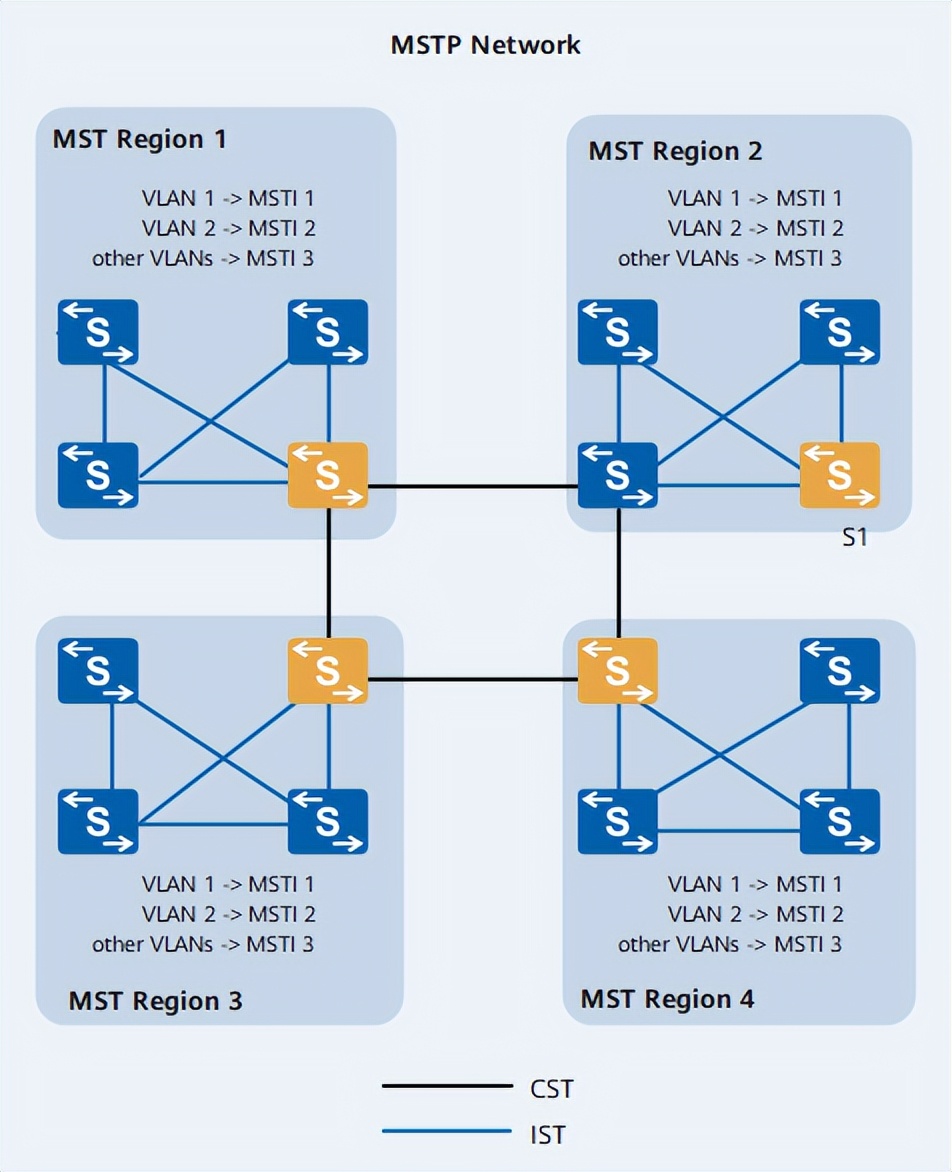
In some large-scale networks, there may be a requirement for multiple VLANs (virtual local area networks) to be accommodated simultaneously. However, STP and RSTP have limited capability to construct only a single spanning tree for the entire network. To address this issue, the Multiple Spanning Tree Protocol (MSTP) was developed. MSTP provides the ability to construct independent spanning trees for each VLAN within the network, offering greater flexibility and scalability.
Multiple Spanning Tree Protocol (MSTP) is a method to further optimize the spanning tree protocol. It allows multiple spanning tree instances to be created in a network, each instance responsible for a different VLAN. In this way, better load balancing and resource utilization can be achieved. MSTP is compatible with STP and RSTP, so it has better flexibility when upgrading or migrating the network.
Differences between STP, RSTP, and MSTP
Convergence time
The convergence time for STP commonly falls within the range of 30 to 50 seconds. This is due to the fact that when a change occurs in the network topology, the port must pass through the three stages of blocking, listening, and learning prior to entering the forwarding state. The extended convergence time can be viewed as relatively sluggish in contemporary networks.
RSTP significantly reduces convergence time by introducing new port roles and states, as well as enhanced BPDU processing mechanisms. The convergence time of RSTP is usually within a few seconds, which is much faster than STP.
MSTP is built upon RSTP and, thus, possesses the rapid convergence feature. Each spanning tree instance (MSTI) is calculated independently by MSTP, resulting in convergence times that are comparable to RSTP, typically within a few seconds.
Compatibility and application scenarios
STP is the earliest spanning tree protocol and is widely used in various network environments. However, its convergence rate has become inadequate in modern networks. STP is more appropriate in smaller networks or those that undergo infrequent changes.
RSTP is backward compatible with STP and can interoperate with devices running STP. RSTP is suitable for modern high-bandwidth, low-latency network environments that require fast convergence, such as enterprise networks and data centers.
MSTP is based on RSTP, has the characteristics of fast convergence, and is backward compatible with STP and RSTP. MSTP is suitable for large-scale, multi-VLAN complex network environments, especially in scenarios that require optimized network resource utilization and load balancing, such as large enterprise networks and wide area networks.
Configuration complexity
STP is relatively simple to configure, but can be complex to optimize and troubleshoot, especially in large-scale networks.
RSTP configuration is similar to STP, but requires the rapid spanning tree mode to be enabled. RSTP's optimization and troubleshooting processes are fairly straightforward and are well-suited for most network environments.
The configuration of MSTP is relatively complex, as it involves setting up MST regions, configuration revision numbers, and VLAN-to-instance mappings. However, despite the complexity, MSTP promises greater optimization and management capabilities, making it a suitable option for large-scale, intricate networks.
In conclusion, STP, RSTP, and MSTP are frequently employed spanning tree protocols in networking, providing crucial support in constructing a steady and dependable topology. As networks expand and needs transform, selecting the appropriate protocol becomes critical to ensuring smooth operation. It is essential for developers to determine the ideal spanning tree protocol in line with network size, topology, and functional requirements, while also competently configuring and managing the network. By doing so, efficient and reliable data communication and transmission can be realized.
What is POE injector?
The difference between ordinary switches and core switches
Related Article