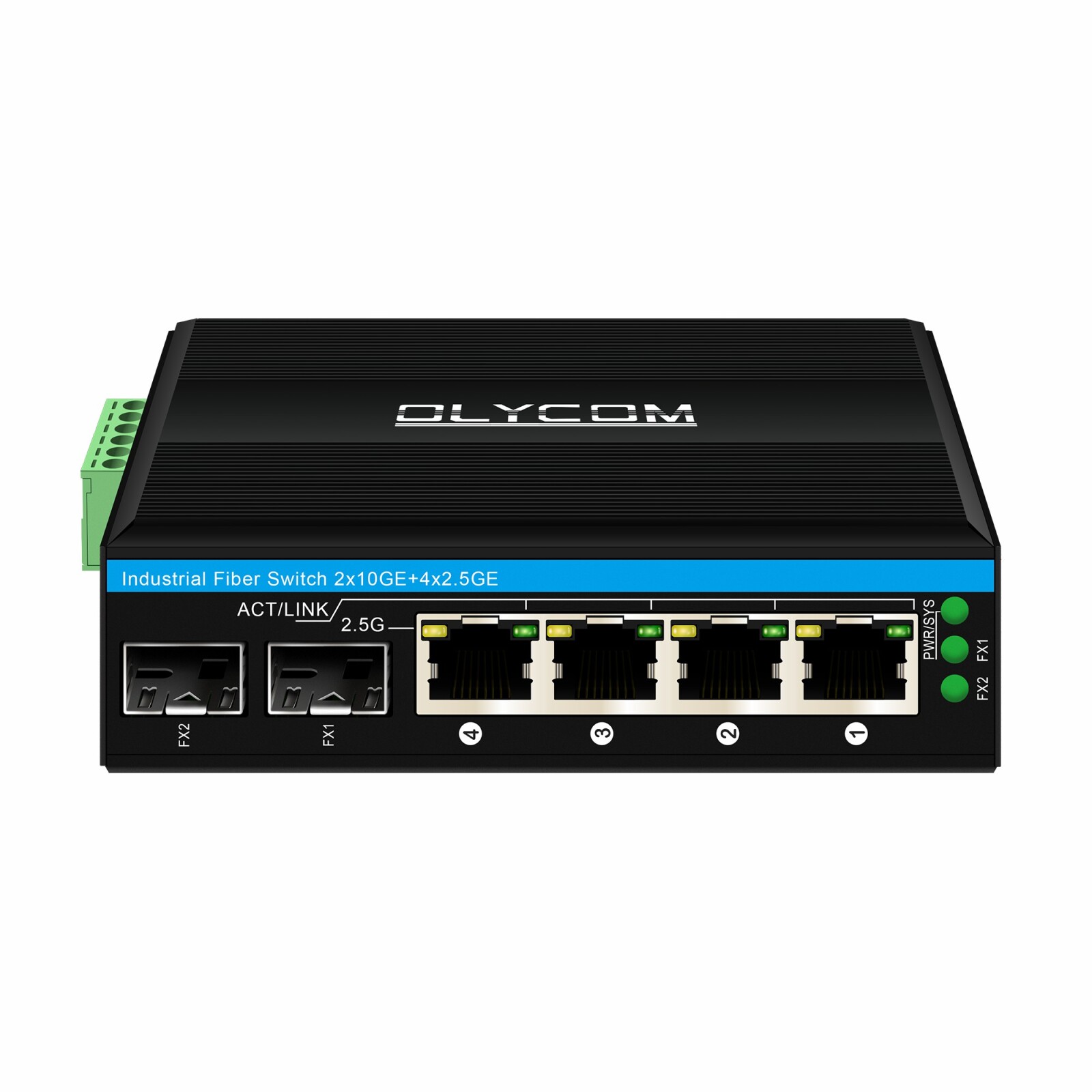
Industrial PoE Switch for Bus Surveillance and Vehicle Network Systems
Project Background
As public transportation systems continue to digitalize, more onboard devices now rely on Ethernet communication and PoE power delivery, including:
- Vehicle IPC surveillance cameras
- Wireless access points
- Mobile NVR systems
- Passenger information displays
- GPS and dispatch terminals
- AI edge computing devices
Compared with conventional office networks, bus networking environments are closer to mobile industrial networking systems.
In this project, the customer was a transportation system integrator deploying a new onboard surveillance and wireless networking system for buses. The project required:
- Using the existing DC24V vehicle power system
- Centralized PoE power delivery for multiple devices
- Reduced dependency on additional power modules
- Simplified vehicle wiring
- Adaptation to vibration and temperature variation during long-term operation
Due to limited installation space, continuous vibration, fluctuating power conditions, and electromagnetic interference inside vehicles, the customer selected the IM-WP054BGE industrial PoE switch instead of a conventional commercial PoE switch.

Why Vehicle Networks Resemble Industrial Environments
Many transportation projects initially underestimate the difference between vehicle networking environments and traditional office environments.
In actual vehicle operation, the onboard network may experience:
- Engine startup transient voltage fluctuations
- Voltage drop across long cable runs
- EMI generated by motors and vehicle electronics
- High summer temperatures
- Low-temperature cold starts
- Continuous vibration
- Heat accumulation inside enclosed cabinets
These operating conditions mean that a conventional commercial switch may function temporarily, but may not be suitable for long-term vehicle deployment.
Industrial switches are therefore commonly used in:
- Public buses
- School buses
- Engineering vehicles
- Mobile surveillance systems
- Transportation networking systems
Why Wide Voltage Input Matters in Bus Projects
Most conventional PoE switches only support 48VDC input.
However, vehicle electrical systems may involve:
- DC12V
- DC24V
- DC48V
If the network switch only supports fixed 48V input, additional components are often required, such as:
- DC-DC converters
- Voltage booster modules
- External power adapters
This increases:
- Installation complexity
- Wiring requirements
- Maintenance points
It also consumes valuable onboard installation space.
The IM-WP054BGE integrates an internal voltage booster and supports:
- DC12V~48V input
- IEEE 802.3af/at compliant active PoE output
Its PoE specifications include:
- Up to 30W per port
- 4 Gigabit PoE ports
- Up to 120W total PoE budget under 48V input
For transportation projects, this wide-voltage design helps directly adapt to existing vehicle power systems without requiring additional power conversion equipment.
Practical Benefits of Industrial PoE Design in Transportation Systems
1. Wide Temperature Operation
Public transportation vehicles may experience:
- High summer heat exposure
- Low-temperature winter startup
- Long-duration enclosed operation
- Heat accumulation in roof-mounted cabinets
The IM-WP054BGE supports:
- Operating temperature: -40°C to 75°C
- Storage temperature: -40°C to 85°C
Compared with conventional commercial switches, it is more suitable for:
- Roof communication compartments
- Surveillance control boxes
- Edge communication cabinets
For vehicle systems, wide-temperature capability primarily means better adaptation to varying environmental conditions.
2. EMC and Surge Protection
Vehicle electrical systems often involve more complex electromagnetic interference than office environments.
Potential interference sources include:
- Engine startup
- Motor operation
- Power switching
- Induced surge from long cable runs
- Coupled interference from onboard electronics
The IM-WP054BGE supports:
- 6KV Ethernet surge protection
- IEC61000-4-2 ESD protection
- IEC61000-4-4 EFT protection
- IEC61000-4-5 surge protection
Its interface protection specifications include:
- Differential ±2KV
- Common Mode ±6KV
These industrial EMC specifications are designed for continuous communication in mobile industrial environments.
3. Metal Housing and Vibration-Resistant Installation
Vehicles generate continuous mechanical vibration during operation.
For onboard networking equipment, vibration may affect:
- Connector stability
- Cable fixation
- Internal structural stress
- Long-term connection reliability
The IM-WP054BGE features:
- Corrugated metal housing
- DIN-rail mounting
- IP40 protection level
- Compact dimensions: 114 × 93 × 35 mm
Compared with plastic commercial switches, this structure is more suitable for:
- Compact equipment compartments
- Metal control cabinets
- Vehicle roof electrical areas
DIN-rail installation also aligns with standard industrial control deployment practices.
Why PoE Is Especially Valuable in Bus Systems
In vehicle projects, the advantage of PoE is not limited to power delivery.
Its main value lies in reducing additional wiring and installation complexity.
For example, if every IPC camera requires an independent power supply, the vehicle may require:
- Additional power adapters
- AC/DC modules
- Extra power harnesses
- More maintenance points
PoE enables simultaneous transmission of:
- Data
- Power
over a single Ethernet cable.
In bus surveillance systems, this means:
- Simplified cabling
- Fewer hardware nodes
- Easier maintenance
- Better suitability for limited installation space
Typical Bus Network Topology
Typical deployment architecture may include:
- 1 × Industrial PoE switch
- 4 × IPC cameras
- 1 × Wireless AP
- 1 × Mobile NVR
- 1 × Passenger information display
The vehicle DC24V power system directly powers the industrial PoE switch, which then supplies PoE power to edge devices.
This structure helps reduce:
- Independent power modules
- Additional wiring harnesses
- Installation complexity
Commercial vs Industrial Switches
Commercial PoE switches are typically designed for:
- Offices
- Retail environments
- Indoor networking systems
These environments generally provide:
- Stable power input
- Controlled temperatures
- Low vibration
- Minimal EMI interference
Bus networking environments, however, are typical mobile industrial environments.
Therefore, industrial PoE switches are more suitable for:
- Public buses
- School buses
- Engineering vehicles
- Mobile surveillance systems
- Intelligent Transportation Systems (ITS)
Transportation and Mobile Networking Applications
In addition to bus systems, wide-voltage industrial PoE switches are commonly used in:
Vehicle Surveillance Systems
Connecting:
- IPC cameras
- Mobile NVR systems
- Edge recording devices
Vehicle WiFi Systems
Supporting:
- Passenger WiFi
- Wireless AP power delivery
- Mobile backhaul networking
Intelligent Transportation Systems (ITS)
Supporting:
- GPS dispatch systems
- AI edge devices
- Data acquisition terminals
Mobile and Renewable Energy Systems
With DC12V~48V input support, the switch is also suitable for:
- Solar-powered systems
- Mobile surveillance equipment
- Temporary communication nodes
- Outdoor mobile networking system
Conclusion
In transportation networking environments, industrial PoE switches are more than ordinary networking devices. They are critical infrastructure components within mobile industrial communication systems.
Compared with commercial switches, bus projects place greater emphasis on:
- Wide voltage input
- Industrial EMC protection
- Wide temperature operation
- Centralized PoE power delivery
- Vibration-resistant installation
- Compact deployment
The IM-WP054BGE supports:
- DC12V~48V wide-voltage input
- IEEE 802.3af/at compliant PoE
- Gigabit Ethernet interfaces
- Industrial EMC protection
- Wide-temperature operation
- DIN-rail industrial installation
making it more suitable for complex onboard and mobile industrial networking environments.
For bus surveillance, vehicle wireless networking, and transportation system integration projects, this type of industrial PoE switch helps simplify power architecture while adapting to diverse industrial operating conditions.
How a Managed Industrial PoE Switch Solved PTZ Camera Power, Monitoring, and Network Reliability Challenges
Case Study: Optical Bypass switch Optimization for Optical Communication System Protection