Campus Network Upgrade: Addressing Multi-Rate Access and Fiber Uplink Requirements
Project Type: Campus Network Upgrade Planning
Industry: Education, Campus Networking, IT System Integration
Product: Olycom OM1X80(2)GE 2.5G Ethernet Switch
Project Background Disclaimer: This article presents a hypothetical project scenario based on common campus network upgrade requirements. It explains potential network challenges and equipment selection considerations rather than describing a completed customer deployment.
1. Project Background: New Access Requirements in Campus Networks
As digital infrastructure continues to develop, university networks need to support an increasing number of connected devices across teaching buildings, computer laboratories, and office areas.
In addition to traditional office computers and network printers, newer endpoint devices are placing higher demands on network access speeds.
In this project planning scenario, an IT system integrator is evaluating a network upgrade for selected areas of a university campus.
During the initial assessment, the project team identifies several areas that require attention, including endpoint access speeds, uplink connectivity, and equipment installation conditions.
The customer wants to support newer high-bandwidth devices without unnecessarily replacing all existing network equipment.
The project therefore requires a switch that can accommodate different Ethernet speeds, provide faster access for compatible endpoints, and support fiber connectivity to upstream network equipment.
2. Three Key Challenges in the Network Upgrade
2.1 Existing Gigabit Access May Not Meet the Requirements of Newer Devices
Many devices across campus networks still use Gigabit Ethernet interfaces. However, some newer network endpoints already support 2.5G connectivity.
If the network continues to rely entirely on traditional Gigabit switches, compatible 2.5G devices may not be able to use their full supported interface speed.
At the same time, replacing every existing network device with higher-speed equipment may increase project costs and installation workload.
The main requirement is to support newer 2.5G endpoints while maintaining compatibility with existing network devices.
Rather than replacing the entire access network, the project needs a more flexible approach that accommodates different endpoint speeds.
2.2 Access Switches Need Suitable Fiber Uplink Connectivity
In a campus network, access switches may need to connect different buildings, offices, and network areas through upstream equipment.
As access speeds increase, the project team also needs to evaluate the connection between access switches and the upstream network.
If an access switch does not provide a suitable fiber interface, additional equipment or changes to the network architecture may need to be considered.
The customer needs an access switch that combines multi-rate Ethernet ports with high-speed fiber connectivity.
2.3 Equipment Noise and Installation Space Matter in Indoor Environments
Not all campus network equipment is installed in dedicated server rooms.
Some access switches may be located in classrooms, offices, laboratories, or local equipment cabinets.
In these environments, equipment noise, physical dimensions, and maintenance requirements can influence product selection.
Traditional fan-cooled equipment may generate additional operating noise and introduce another mechanical component that requires maintenance.
The project therefore also needs to consider switches suitable for indoor network environments where operating noise is a concern.
3. Proposed Solution: 2.5G Ethernet Access with 10G Fiber Uplink
To address these requirements, the project team can consider the Olycom OM1X80(2)GE as an access switch for selected network nodes.
The proposed design uses multi-rate RJ45 ports to connect endpoint devices and an SFP fiber interface to connect upstream network equipment.
3.1 Supporting Different Endpoint Speeds with Multi-Rate RJ45 Ports
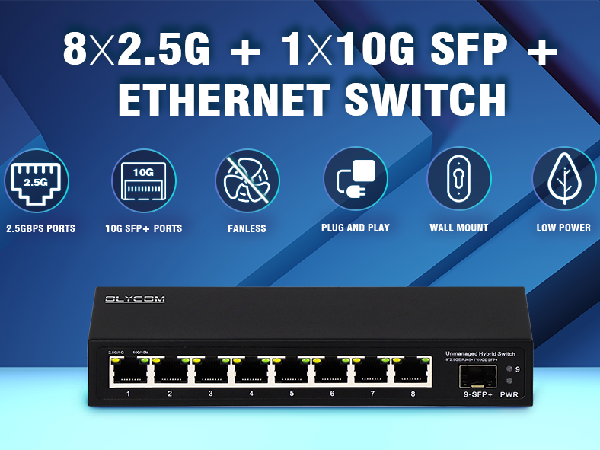
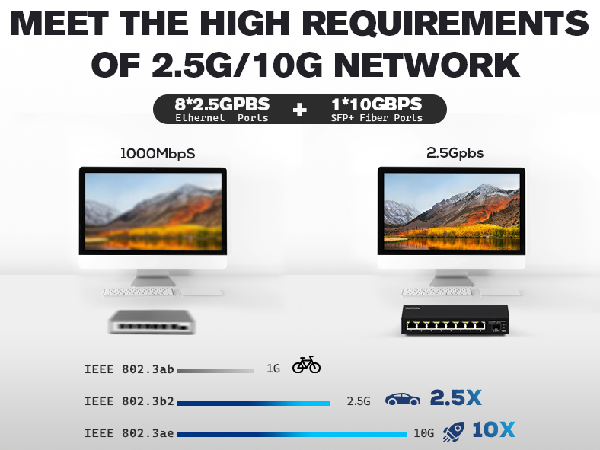
The OM1X80(2)GE provides eight RJ45 ports supporting 10M/100M/1G/2.5G Ethernet.
This allows the switch to connect traditional Fast Ethernet and Gigabit devices alongside newer 2.5G-capable endpoints.
For customers gradually upgrading their campus networks, this multi-rate access configuration provides greater flexibility when different generations of network devices operate within the same environment.
The project does not need to replace every existing endpoint simply because some newly installed devices support 2.5G Ethernet.
The additional 2.5G capability also provides an access option for compatible devices introduced during future network upgrades.
3.2 Meeting Uplink Requirements Through a 10G SFP Fiber Interface
To address the connection requirements between the access and upstream networks, the OM1X80(2)GE includes one SFP fiber interface supporting 1G/2.5G/10G.
Project engineers can select the appropriate link speed and optical module according to the upstream switch, existing fiber infrastructure, and required transmission distance.
For example, when both connected devices support 10G and the optical modules and fiber specifications are compatible, a 10G fiber link can be used between the access switch and upstream network equipment.
This provides a combined solution for multi-rate Ethernet access and fiber uplink connectivity.
Actual link speed depends on the capabilities of both devices, optical modules, and fiber configuration. Compatibility should be verified before deployment.
3.3 Reducing Operating Noise with a Fanless Design
For equipment installed in teaching buildings and office areas, the OM1X80(2)GE features a fanless design.
By eliminating cooling fans, the switch avoids fan-generated operating noise and reduces maintenance considerations associated with fan components.
Its compact physical design also allows project engineers to evaluate installation in equipment cabinets and other available indoor spaces.
However, appropriate ventilation and heat dissipation must still be considered during installation.
4. How the Proposed Solution Addresses the Project Requirements
By adopting a switch with multi-rate access ports and fiber uplink connectivity, the project can address several network planning requirements.
Supporting existing and newer devices. Multi-rate RJ45 ports allow different Ethernet endpoint speeds to operate through the same access switch.
Simplifying access switch selection. Combining multi-rate copper ports and a high-speed fiber interface provides an integrated equipment option for network nodes requiring both connection types.
Providing flexible uplink connectivity. The SFP interface supports speeds up to 10G, allowing the project team to select an appropriate uplink according to the upstream equipment and fiber infrastructure.
Addressing indoor noise considerations. The fanless design eliminates fan operating noise, making the switch a candidate for evaluation in offices, laboratories, and other indoor network environments.
The actual outcome of a network upgrade depends on the existing topology, endpoint capabilities, traffic requirements, and upstream network configuration. Site-specific design and verification remain necessary.
5. Key Considerations Before Deployment
Before installation, the system integrator should verify several aspects of the proposed network design:
-
Endpoint compatibility: Confirm that devices requiring 2.5G access support the corresponding network interface speed.
-
Uplink compatibility: Verify that the upstream switch supports the selected SFP interface speed.
-
Optical module selection: Match optical modules to the transmission distance, fiber type, and wavelength requirements.
-
Bandwidth planning: Evaluate the number of connected devices and concurrent traffic to determine whether the uplink capacity is sufficient.
-
Installation conditions: Check power supply, operating temperature, available space, and ventilation.
These checks help ensure that switch selection considers the entire network connection rather than relying only on the nominal port speeds.
6. Conclusion
For educational institutions and IT system integrators planning campus network upgrades, switch selection requires consideration of existing endpoint compatibility, higher access speeds, uplink connectivity, and installation conditions.
The Olycom OM1X80(2)GE combines eight multi-rate RJ45 ports with one SFP fiber interface supporting speeds up to 10G. It provides an equipment option for network nodes requiring 2.5G Ethernet access and high-speed fiber uplink connectivity.
Beyond campus networks, this type of access configuration can also be considered for enterprise office networks, computer laboratories, and other indoor network upgrade projects.
Case Study: IP67 M12 Waterproof Industrial Switch for Outdoor Automation Network Deployment