How to choose the right PoE switch for your IP Surveillance cameras?
What is a PoE switch for IP cameras?
Power over Ethernet (PoE) is a technology that streamlines cabling by enabling power and data to be transmitted through a single Ethernet cable. This can include Cat5, Cat5e, and Cat6 cables. PoE switches are typically equipped with several ports, making them capable of powering multiple PoE-enabled devices simultaneously. Examples of such devices include IP cameras, computers, VoIP phones, and other network-enabled devices.
Today, PoE switches are commonly used in security surveillance systems, not only because Ethernet cables are cheap and easy to run, but also because PoE and IP technology support high-resolution cameras, providing higher video quality for IP camera systems.
Why use a PoE switch for an IP camera system?
A PoE switch is a crucial device that enables the seamless connection and power delivery to IP network cameras through Ethernet cables. Its key role in an IP camera system is to interconnect the cameras to NVRs, facilitating the smooth transmission of data such as video and audio to be recorded on the devices. Typically, a PoE switch comes with multiple ports that support connections to numerous network cameras, making it an ideal solution for larger surveillance settings.
Moreover, a PoE switch that possesses higher power capacity can easily support power-hungry IP cameras that demand more power. Low power supply to an IP camera can result in faulty video output and poor performance, which can be easily avoided by utilizing PoE switches with adequate power delivery.
To sum up, a PoE switch offers several advantages for your IP camera system, including longer operational distances, the ability to connect more devices, greater power output to network cameras, and easier management with activity lights for troubleshooting.
How to choose the right PoE switch for your IP camera system?
In order to select the appropriate, trustworthy, and best PoE switch for your IP security cameras, there are several pertinent factors you must take into account:
These cameras not only need power, but also require a PoE switch to ensure a stable network connection. It's important to note that different switches have varying bandwidth capabilities. For instance, Fast Ethernet PoE switches typically provide speeds ranging between 10 to 100 Mbps, while Gigabit PoE network switches offer 1 Gbps. Additionally, the number of ports on the PoE switch and its power supply capabilities are also basic considerations. Before setting up, count the number of IP cameras that will connect to the switch and evaluate their power requirements.
Make sure the power supply voltage of the switch meets the voltage requirements of the network camera. Using the wrong power supply voltage may result in camera malfunction, leading to permanent demage.
Power budget
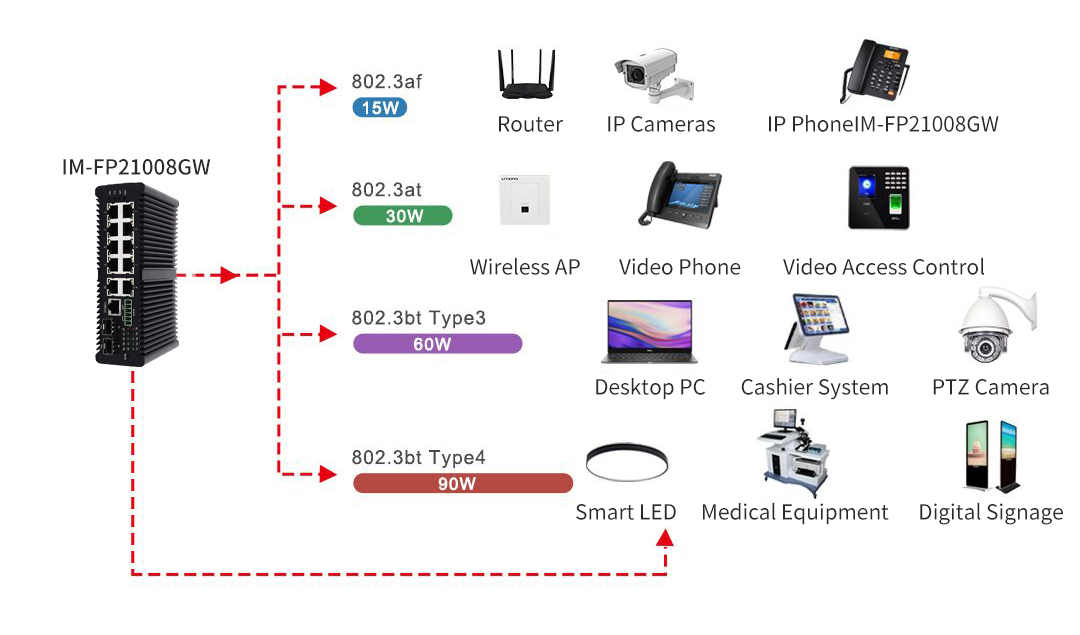
The power budget of a PoE switch refers to the maximum power it can provide. The additional total power of connected devices should not approach or exceed the switch's maximum power budget. When selecting a switch, it is important to check the budget for each port to ensure it is sufficient to power your IP cameras.
Managed vs. Unmanaged PoE Switches
When it comes to PoE switches, the decision of whether to use managed or unmanaged switches largely depends on your specific requirements. Unmanaged switches are plug-and-play and require no configuration. These are suitable for home users and simple setup. However, if you are looking for advanced features such as network optimization, remote control, and deeper visibility into network status, then you should consider using managed PoE switches. Managed switches are perfect for larger, more complex network monitoring projects, such as businesses or large facilities.
Tips for choosing the right PoE switch for your IP camera system based on your needs
To make an informed decision, consider the following tips:
1. Calculate Power Requirements: First and foremost, you need to know how much power your IP cameras require. Once you have determined this, make sure that the switch's power budget can accommodate them.
2. Future-Proof Your System: If you anticipate expanding your camera system in the future, it's a good idea to choose an IP switch with additional ports. This will provide room for growth without the need to purchase a new switch.
3. Consider Harsh Environments: If your cameras will be installed in harsh environments, such as outdoor settings or industrial facilities, opt for an industrial PoE switch that can withstand extreme conditions.
4. Look for Managed PoE Network Switches: For large-scale monitoring projects, a managed PoE network switch is ideal. This type of switch provides greater flexibility, control, and oversight, making it easier to manage a large number of cameras and devices.
Overall, choosing the right PoE switch for your IP camera system is crucial to building an efficient and reliable IP camera system. You can tailor it to your specific requirements by taking into account elements such as port numbers, supply voltage, power budget, maximum power, bandwidth capacity, and managed/unmanaged switch options.
What is Media Redundacncy Protocol(MRP)?
HD-SDI to fiber converter
Related Article