The difference between ordinary switches and core switches
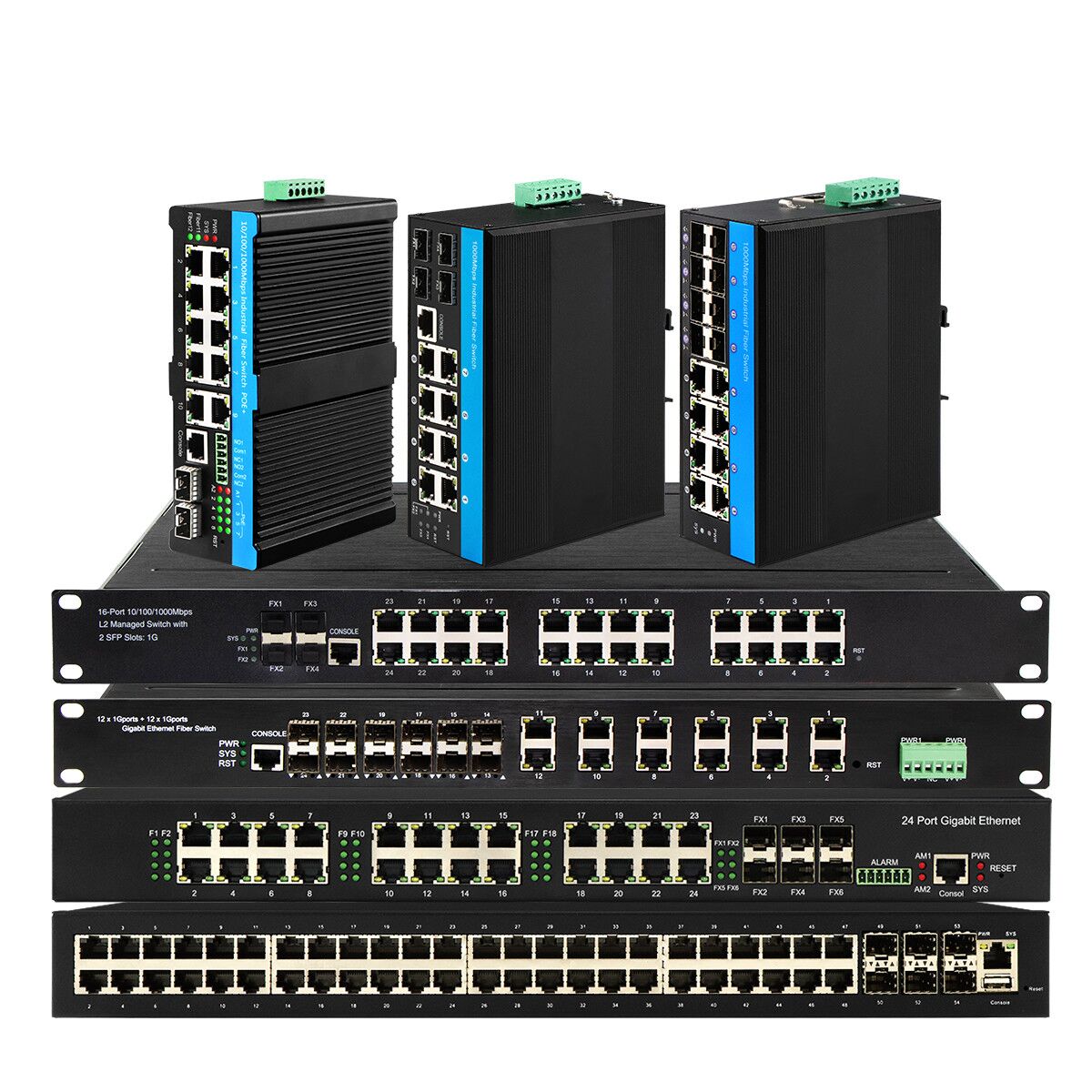
A ordinary switch is one of the most basic devices in a network, responsible for communication between devices within a local area network. A ordinary switch is mainly used to connect devices within a local area network (LAN). It acts as a relay point to connect computers, printers, servers, and other network devices. Through a ordinary switch, these devices can exchange data quickly and reliably directly within the LAN.
Core switch is not a type of switch. It is usually placed in the backbone core of the network, so it is called core switch. Core switch plays a vital role in network architecture. It is located in the backbone or physical core of the network and is a key device that connects different parts. As a high-capacity switch, it is responsible for connecting different network subnets and assumes the core function of the entire network. The core switch is the main distribution center of data traffic and needs to be powerful enough to handle a large amount of data flow.
The difference between ordinary switches and core switches
1. Port Difference
Typically, ordinary switches include between 24 and 48 ports, with the majority of network ports being either Gigabit Ethernet or 100M Ethernet. Their primary purpose is to access user data or consolidate switch data on the access layer. These types of switches generally feature basic Vlan routing protocols and simple SNMP functions, and their backplane bandwidth is relatively limited.
The core switch typically comes equipped with a high number of modularized ports, allowing for the option to pair with optical or Gigabit Ethernet ports. As a three-layer switch, it supports advanced network protocols such as routing, ACL, QoS, and load balancing. The most critical feature of a core switch is its backplane bandwidth, which far exceeds that of an ordinary switch. Its engine module is usually separate and functions as a primary and standby system.
2. Different application levels
Ordinary switches are primarily utilized in the access layer, while core switches are reserved for use in the core layer. Consider a monitoring center with a core computer room and multiple monitoring points. The network connecting these points typically relies on ordinary switches with basic forwarding capabilities. On the other hand, the computer room requires a core switch as it serves to aggregate data from numerous monitoring points.
3. The difference between connecting or accessing the network
The segment of the network that manages user access or connection is commonly referred to as the access layer, while the section between the access layer and the primary core layer is known as the distribution or aggregation layer. The access layer is designed to enable end-users to connect to the network, hence the access layer switch is characterized by its high port density and cost-effectiveness.
The aggregation layer switch is the aggregation point of multiple access layer switches. It must be able to handle all traffic from access layer devices and provide uplinks to the core layer. Therefore, the aggregation layer switch has higher performance, fewer interfaces and higher switching rate.
The main part of the network is called the core layer. The main purpose of the core layer is to provide an optimized and reliable backbone transmission structure through high-speed forwarding of communications. Therefore, core layer switching applications have higher reliability, performance, and throughput.
4. Large Cache Technology
The core switch boasts a distributed cache architecture with a significantly larger cache capacity than typical switches. Its cache can exceed 1G, while regular switches top out at 2-4m. Moreover, each port can handle a burst traffic cache capacity of up to 200ms at the full line speed of 10G. Consequently, the switch's ample cache guarantees zero packet loss during network forwarding when dealing with bursts of traffic, even with high-density server scheduling. This innovative feature ensures business continuity and improves efficiency.
5. Large-capacity equipment
In data center environments where there is a high volume of network traffic and complex scheduling, core switches must be equipped with larger capacity to support the scheduling of high-density applications and cope with traffic surges. Compared to ordinary switches, core switches offer a higher port density and larger forwarding capacity to ensure exceptional and dependable network performance.
6. Virtualization technology
Data center switches should incorporate virtualization technology for the transformation of physical resources into logically manageable resources. This technology allows for a unified management system for multiple network devices, enabling precise identification and control of services. Implementing virtualization can reduce management expenses and enhance IT utilization for data center switches.
7. TRILL technology
The traditional Spanning Tree Protocol (STP) has some shortcomings when it comes to expanding ultra-large data centers, including resource wastage and low network forwarding efficiency. However, the introduction of Transparent Interconnection of Lots of Links (TRILL) technology has addressed these shortcomings. By seamlessly integrating second layer configuration and flexibility with third layer functionality, the TRILL technology enables the network to achieve loop-free forwarding and significantly enhance forwarding efficiency.
8. FCoE technology
Traditional data centers typically consist of separate data and storage networks. With the advent of FCOE technology, network convergence is now achievable. FCoE encapsulates storage data frames within Ethernet frames for forwarding. This implementation of convergence technology requires switches within the data center, as ordinary switches lack these functions. Additionally, link aggregation, redundancy, stacking, hot backup, and other critical functions determine the efficiency, stability, and performance of the core switch in real-world applications.
Olycom's industrial switches are complete and rich in variety, and have been tested by the market for nearly 20 years. If you have any needs, please come to learn more and communicate.
Differences between STP, RSTP, and MSTP
Optical line protection system (OLP)
Related Article